Atlas and Salesforce: Different Product Categories
Atlas and Salesforce: Different Product Categories
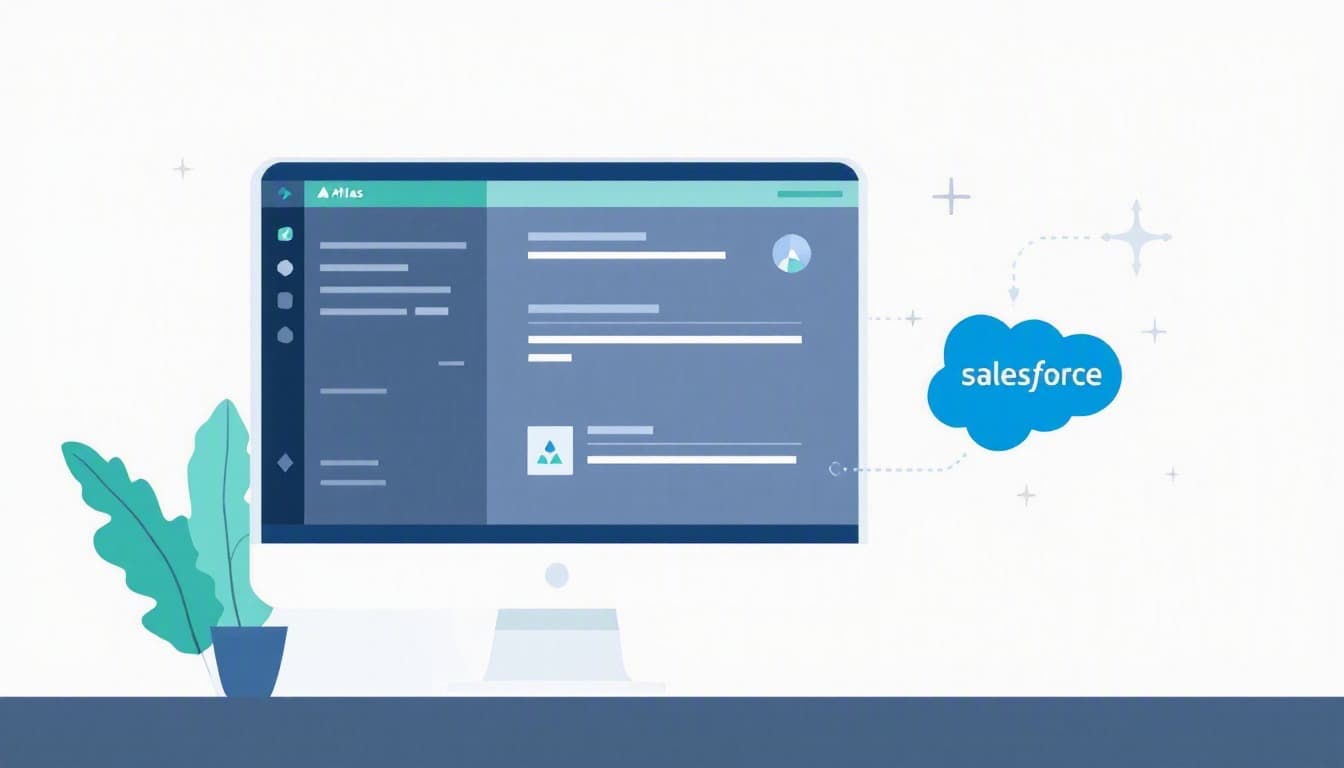
Atlas and Salesforce should not be compared as though they are two versions of the same CRM.
Salesforce is an established enterprise customer-platform ecosystem with extensive configuration, partner, application, and industry capabilities.
Atlas is the flagship Business AI Harness from Joyful Innovation.
CRM is one operating surface inside Atlas. The broader product connects models, agents, customer and work records, approved knowledge, tools, workflows, permissions, human decisions, audit history, cost attribution, and measurable outcomes.
The useful question is not which product has the longer feature list.
The useful question is which operating model the organization is trying to build.
Salesforce centers the enterprise customer platform
Salesforce is designed around a large, configurable customer platform and ecosystem.
Organizations may choose Salesforce when they require:
- Deep CRM configuration
- Extensive partner and consulting support
- A broad application marketplace
- Established industry-specific products
- Complex enterprise sales and service processes
- Existing Salesforce skills and investment
- Procurement familiarity with a long-established vendor
Those capabilities can be strategically important.
They also create an operating model that may involve specialized administration, implementation partners, configuration governance, and multiple products across the ecosystem.
Atlas centers the Business AI Harness
Atlas begins with a different architectural question:
What system is required to connect intelligence to the actual work of the business?
The Atlas harness includes:
- CRM and relationship context
- Communications
- Projects and operational work
- Content and marketing
- Websites and forms
- Approved knowledge
- Analytics
- Low-code applications
- Model routing
- AI assistants and supervised agents
- MCP and controlled tool access
- Human approvals
- Audit history
- AI usage and cost attribution
- AI Value Indicators
The product is designed so the intelligence, records, tools, policy, people, and outcomes participate in the same operating layer.
The main architectural difference is the role of AI
In a conventional enterprise platform, AI may be delivered through assistants, copilots, automation features, analytics, and add-on products around an established application architecture.
Atlas is designed as an AI Harness from the beginning.
That means the architecture considers:
- Which model should handle each workload
- What business context the model can reach
- Which tools an agent can use
- Which actions require approval
- How people can intervene
- How actions are audited
- How cost is attributed
- How outcomes are measured
- How the system learns from decisions and results
The model is not treated as the product.
The governed system around the model is the product.
CRM depth and harness breadth are different evaluation questions
A CRM evaluation typically asks:
- Can the system model our accounts, contacts, opportunities, activities, and sales processes?
- Can it support our reporting, service, marketing, and integration requirements?
- Can our administrators configure and govern it?
An AI Harness evaluation adds different questions:
- Can the intelligence reach complete business context?
- Can models be selected by workload?
- Can agents use tools without receiving unlimited authority?
- Are material actions permissioned and reviewable?
- Can a person intervene?
- Is every action attributable and auditable?
- Can cost be connected to the workflow and actor?
- Can the organization measure whether the outcome improved?
- Can the system learn from approvals, corrections, and results?
An organization may need one set of capabilities, the other, or both.
When Salesforce may fit the operating model
Salesforce may be a strong fit when the organization:
- Already has significant Salesforce investment and expertise.
- Requires a mature enterprise CRM ecosystem.
- Depends on specialized industry or partner solutions.
- Needs extensive configuration around established sales and service operations.
- Has governance and administration processes designed around the Salesforce ecosystem.
When Atlas may fit the operating model
Atlas may be a strong fit when the organization:
- Is designing around AI-native operations rather than adding isolated AI features.
- Needs CRM, work, knowledge, content, models, agents, and governance to share context.
- Wants workload-based model routing and provider portability.
- Requires approval-first execution and detailed auditability.
- Wants AI usage connected to business-specific AI Value Indicators.
- Values a coherent intelligence and execution layer around several business functions.
The products may also coexist
A Business AI Harness does not have to replace every established system immediately.
An organization may retain Salesforce as a system of record while using a harness to coordinate intelligence, knowledge, tools, approvals, and outcomes across Salesforce and other operating systems.
The architecture should make authority explicit:
- Which system owns each record?
- Which actions can the harness perform?
- Which actions require review?
- How are changes synchronized?
- How are failures handled?
- Where is the audit history retained?
- How is the business outcome measured?
Do not reduce the decision to price
Joyful Innovation does not position Atlas as the cheap version of Salesforce.
Atlas is a premium, modern Business AI Harness with a different category strategy.
Commercial terms matter, but the primary decision should be based on architecture, operating model, governance, implementation requirements, and the business outcomes the organization needs to create.
A practical comparison process
Before choosing or replacing either system:
- Define the records and workflows that matter.
- Identify the current systems of authority.
- Document the AI use cases and required tools.
- Define permissions and approval boundaries.
- Identify the outcomes and AI Value Indicators.
- Evaluate the implementation and governance model.
- Test the real workflows rather than comparing marketing checklists.
A long feature table can make two products look directly comparable.
The operating model usually reveals that they are solving different problems.
See it on your own data.
Connect your tools and Atlas shows you what matters.
Keep reading
Related resources
Newsletter
The consolidation memo.
Practical insights on AI, operations, and the future of business software. No fluff.
If the form does not load, open it directly in Atlas or Email hello@joyfulinnovation.com.